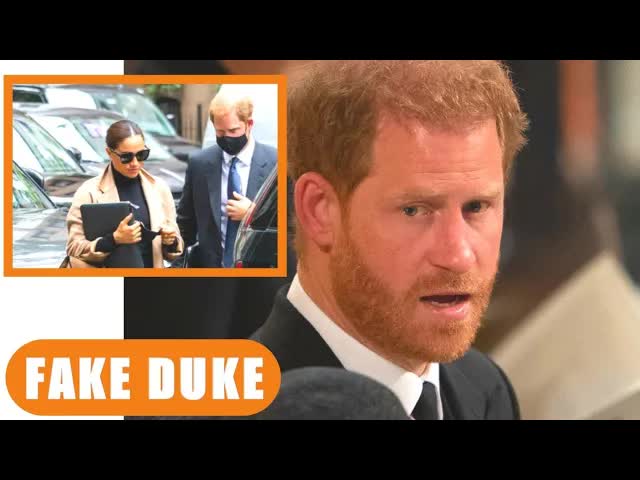
In a striking display of his dwindling fame, Prince Harry‘s recent outing in New York City painted a revealing picture of his life post-royalty.
Once a magnetic figure who effortlessly drew crowds, the Duke of Sussex now finds himself navigating the bustling streets of Manhattan in search of an audience.
This peculiar scene unfolded on a quiet Tuesday morning, where Harry’s planned stroll turned into more of a fleeting walk, leaving many locals unimpressed.
As he stepped out onto the streets, the atmosphere was decidedly calm.
New Yorkers, well-known for their indifference to celebrity culture, went about their day, many briskly passing by with coffee cups in hand and smartphones raised.
Some even voiced their confusion, asking, “Who’s that guy?”
The security detail surrounding Harry was more prominent than the small number of curious onlookers, creating an almost surreal bubble around him.
Among the few who paused to look, it seemed that the spectacle of security was more captivating than the Prince himself.
One local office worker, Sarah Martinez, expressed her disappointment, saying, “I thought maybe it was a movie shooting.
Then someone said it was Prince Harry, and honestly, I was kind of disappointed it wasn’t Bradley Cooper.”
This reaction highlights the challenge Harry faces in maintaining his public image without the royal backdrop.
The absence of Meghan Markle during this trip also raised eyebrows.
While she focuses on their children and various projects back in California, her strategic withdrawal from public appearances could indicate a shift in their branding efforts.
Sources suggest that this separation might be a calculated move, although its effectiveness is still up for debate.
Media analysts are observing a troubling trend for the Sussexes.
Jennifer Chen, a media expert, noted a noticeable decline in public engagement.
“The novelty factor has worn off,” she explained.
Without the royal machinery backing them, Harry and Meghan are struggling to maintain the same level of fascination they once commanded.
As Harry attempted to engage with the sparse crowd, his discomfort became increasingly evident.
His trademark charm appeared forced, with a strained smile as he navigated the awkwardness of the moment.
The contrast between this experience and the charisma he exuded alongside his brother William during royal duties was stark.
Local businesses along the route seemed unfazed by the royal presence.
Despite prior notice of Harry’s visit, shop staff continued their routines, barely acknowledging the entourage.
Hot dog vendor Tom Klein remarked, “In New York, unless you’re stopping traffic for a good reason, you’re just another person holding up the morning rush.”
The timing of this outing coincides with various Sussex projects needing public attention, raising questions about their relevance.
With pressure mounting on their Netflix deal and the conclusion of their Spotify partnership, the stakes have never been higher for the couple.
It appears that Harry is caught in a complex web, trying to sustain his public persona while distancing himself from the institution that once defined him.
This New York appearance serves as a metaphor for the broader challenges facing the Sussexes.
The transition from royalty to celebrity comes with its own set of hurdles.
Maintaining public interest is proving to be a daunting task, especially as the initial intrigue surrounding their royal exit begins to fade.
As Harry engaged with the few who showed interest, there was a palpable sense of forced enthusiasm in the air.
His security team seemed more focused on managing an imaginary crowd than addressing actual admirers, adding an almost theatrical element to the event.
This starkly contrasted with previous visits to New York, where the promise of seeing Harry and Meghan together attracted more significant attention.
With Harry swiftly ushered into a waiting vehicle at the event’s end, the streets returned to their usual hustle and bustle.
This scene underscored the fragile nature of fame, particularly when it is stripped of its royal context.
As the world shifts its gaze, one can’t help but ponder the future of Sussex public appearances—where careful planning meets public indifference.
Harry’s latest outing in New York highlights a stark reality: the path ahead may be fraught with challenges.
The question remains whether this moment is a temporary setback in their evolving narrative or indicative of a more permanent shift in how the public perceives them.
As the city resumed its rhythm, barely acknowledging the royal visitor, it became clear that the allure of the Sussex brand is waning, leaving Harry to grapple with a new and uncertain reality.