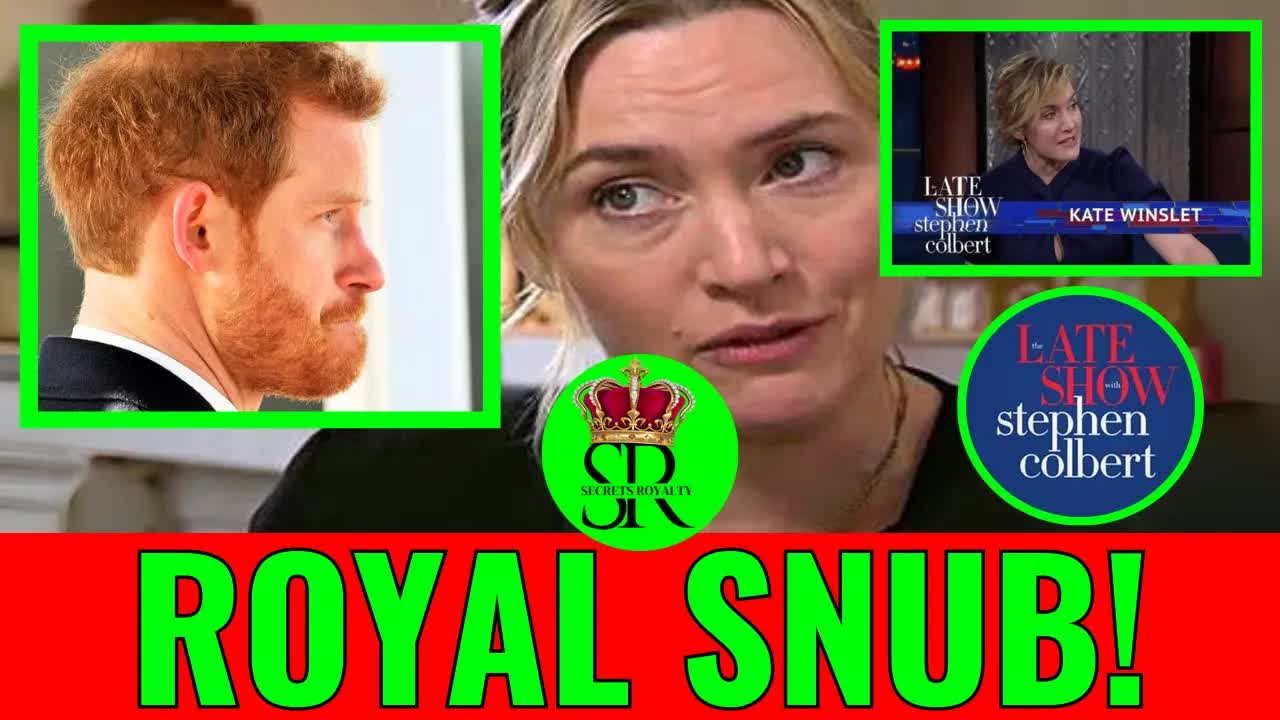
In a jaw-dropping moment that left viewers in disbelief, Prince Harry walked off the set of The Late Show with Stephen Colbert after an intense confrontation with actress Kate Winslet.
What began as a typical late-night chat took a dramatic twist when Winslet challenged Harry’s assertion of being a private citizen.
Her pointed question about whether he still clings to his royal title for fame and financial gain ignited a fiery exchange that has everyone buzzing.
The atmosphere was electric as Prince Harry settled into his seat on the show, greeted by Colbert’s trademark humor.
Initially, the conversation flowed smoothly, touching on Harry’s new life in California, his memoir, and various public initiatives.
But things took a turn when Winslet, also a guest that evening, posed a question that had been lurking in the background.
She asked him directly, “Are you still a prince, or just playing one when it suits you?” The audience gasped, sensing the tension in the air.
Harry quickly defended his royal status, asserting, “I am still a prince by birth.
That doesn’t change because I chose to step back from royal duties.” Winslet, however, remained unfazed and countered his claim with a sharp critique: “But you can’t have it both ways, can you?
If you’ve renounced the responsibilities, should you still hold on to the title?” This back-and-forth escalated, leaving even Colbert scrambling to maintain control of the conversation.
As the exchange heated up, Winslet pressed further, questioning Harry’s desire for independence.
“If you’ve left the institution, why do you still use your title?” she asked.
“Why do you expect deference as a royal when you claim to want to be a private citizen?” Harry, visibly agitated, retorted, “That’s not how it works.
My lineage and history don’t disappear just because I want to protect my family’s privacy.” Winslet shot back, “Actions speak louder than bloodlines, don’t they?
You don’t get to claim royal privilege while rejecting royal duty.”
The audience was split, with some nodding in agreement while others murmured disapproval.
This confrontation was unlike anything typically seen on late-night television.
It was raw and revealing, exposing Harry’s contradictions in real-time.
Eventually, the tension reached its breaking point.
Frustrated, Harry declared, “I don’t need to explain myself to you,” before removing his microphone and storming off the stage.
Colbert, taken aback, attempted to salvage the situation, but Winslet simply shrugged and took a sip of water, remarking, “I guess I hit a nerve.” The audience sat in stunned silence, realizing they had just witnessed a significant moment in the ongoing dialogue about royal identity.
Reactions on social media were swift and polarized.
Hashtags like #HarryStormsOff and #KateWinsletTellsTheTruth began trending almost immediately.
Users were deeply divided; some hailed Winslet for her candidness, while others criticized her for overstepping.
Piers Morgan quickly sided with Winslet, tweeting, “Kate Winslet says what we’ve all been thinking.
Harry wants royal privilege without royal duty.” Conversely, Harry’s supporters defended him, arguing that he has every right to define his own identity.
Major news outlets also weighed in, with the Times describing the incident as a pivotal moment in the monarchy debate.
CNN questioned Harry’s ongoing struggle to find his place in the world.
This incident has highlighted the complexities surrounding Harry’s role and the monarchy itself, emphasizing that the conversation about royal relevance is far from settled.
This exchange didn’t just spotlight Harry’s personal dilemmas; it reignited broader discussions about the monarchy in contemporary society.
In a time of economic uncertainty, many Britons are grappling with the idea of a privileged royal class.
Polls indicate a decline in public support for the monarchy, especially among younger generations.
Harry’s situation embodies the contradictions of modern royalty—wanting to appear relatable and independent while still benefiting from royal status.
Winslet’s challenge transcended Harry; it questioned the very existence of royalty in today’s world.
The immediate aftermath shows a clear divide: Harry’s critics feel justified, while his supporters rally around him.
This raises pressing questions about his future public image.
Will he finally sever ties with the royal family and relinquish his title?
Or will he continue to navigate the complexities of royal status while claiming to be a private citizen?
As this debate unfolds, one thing is certain: Harry may have stormed off the stage, but the conversation he sparked is just beginning.
The implications of this exchange resonate beyond the immediate spectacle, prompting a deeper examination of the monarchy’s future and its place in a rapidly changing society.