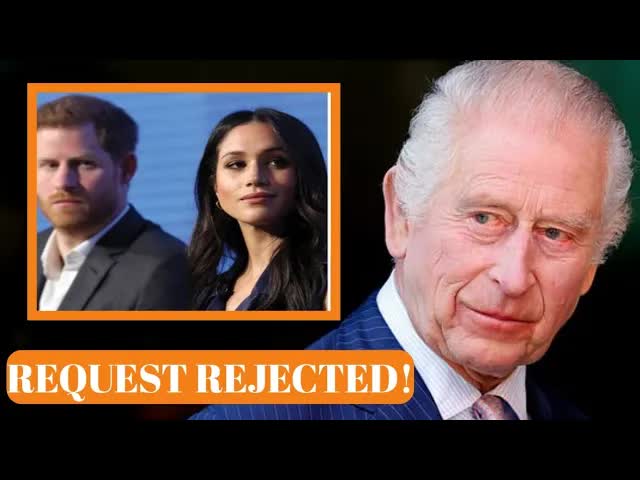
In a dramatic turn of events, King Charles III has decisively rejected Prince Harry‘s recent proposal to elevate Meghan Markle to the prestigious role of Counsellor of State.
This position would have allowed her to act on behalf of the monarch, marking a significant shift in the already strained dynamics within the royal family.
Sources from Buckingham Palace indicate that Harry’s request was swiftly dismissed, highlighting the deepening rift between him and his father.
This revelation comes at a time when tensions are palpable within the royal household.
Once seen as a beloved member of the family, Prince Harry now finds himself teetering on the brink of royal exclusion.
Insiders suggest that this latest confrontation could herald one of the most significant crises the monarchy has faced since the abdication of Edward VIII, with whispers of Harry potentially being removed from the line of succession altogether.
According to a senior royal aide who spoke on the condition of anonymity, King Charles was “absolutely livid.” The notion that the Duchess, who has openly criticized the institution, could be entrusted with such a role was perceived as a grave affront to the Crown.
The Counsellor of State role is traditionally held by senior royals who can perform official duties when the monarch is unavailable.
Currently, this responsibility lies with Queen Camilla, Prince William, Princess Anne, and Prince Edward, as well as Prince Harry and Prince Andrew, despite their non-active royal status.
Harry’s suggestion to include Meghan in this elite group has been characterized by royal commentators as an extraordinary overreach.
Dr. Malcolm Thornton, a Royal Historian at Cambridge University, weighed in, stating, “What we’re witnessing is unprecedented.” He pointed out that Harry seems to be leveraging his royal lineage to gain influence for Meghan, despite their mutual decision to step back from royal duties.
The confrontation reportedly took place during a private meeting at Clan’s House three weeks ago.
Harry, who had traveled to London solo, presented a list of conditions for his potential return to royal duties, with the demand for Meghan to be granted Counsellor status topping the list.
While the King initially listened, his patience waned when Harry insisted that Meghan deserved equal standing with other senior royals.
The King made it clear that the monarchy is not a platform for personal ambitions but a service-oriented institution.
Following this heated exchange, communication between father and son has reportedly come to a standstill.
Harry returned to Montecito the next day, cutting his visit short.
More troubling for him is the growing chatter among palace officials about the constitutional ramifications of his continued place in the line of succession.
Lady Victoria Burnham-Hughes, a former lady-in-waiting to the late Queen Elizabeth II, noted, “There’s a growing consensus within palace circles that the Duke cannot continue to enjoy the privileges of his position while simultaneously undermining the institution.”
For Meghan, this rejection signifies yet another hurdle in her quest to maintain royal relevance after stepping away from royal duties.
Since moving to California, she has often invoked her royal ties in various business ventures, much to Buckingham Palace’s dismay.
Observers have suggested that Meghan appears eager to retain the prestige of royalty without the accompanying responsibilities.
This latest move indicates a desire for actual constitutional power, which would be unprecedented for someone who opted to leave royal life behind.
Concerns among senior royals are intensifying, particularly for Catherine, the Princess of Wales, who reportedly is troubled by Meghan’s attempts to reinsert herself into the royal framework she once rejected.
“Catherine believes firmly in the sanctity of the institution,” said a source close to her.
Meanwhile, Prince William has remained silent on the matter, though he is said to support his father’s stance wholeheartedly, viewing Harry’s request as indicative of a disconnect from the realities of constitutional monarchy.
Legal experts have pointed out that removing Prince Harry from the line of succession would require an Act of Parliament, a significant step not taken since the Succession to the Crown Act in 2013.
However, stripping him of his Counsellor of State status could be executed more easily through royal prerogative.
Constitutional scholar Professor Elaine Harrington explained that the Sovereign holds considerable discretion in appointing Counsellors of State, allowing for exceptions to the traditional rules.
This controversy arrives at a particularly sensitive time for the monarchy, as King Charles navigates the early stages of his reign amid health challenges and a need for modernization.
His focus has been on streamlining the monarchy to ensure its relevance for future generations.
A palace spokesperson conveyed that royal status comes with obligations of service, and those who choose not to fulfill these duties cannot expect to retain royal privileges.
For Prince Harry, the implications of this rejection extend far beyond the immediate fallout.
Sources indicate that King Charles’s advisors are conducting a thorough review of Harry’s remaining royal connections, including military appointments and patronages.
There’s a growing sentiment that a “half in, half out” approach is no longer sustainable.
As one advisor stated, “The duke chose to step away from royal duties, and there must be consequences to that decision.”
Public sentiment in Britain appears to be largely in favor of the King’s decision.
Recent polling indicates that 68% of Britons believe Prince Harry should be removed from the line of succession, with even higher opposition to any official role for Meghan.
Political analyst Rebecca Sanderson noted that the British public values consistency and duty, expressing little appetite for accommodating demands from those who have distanced themselves from royal responsibilities.
Meanwhile, in California, the Duke and Duchess of Sussex have maintained a low profile regarding the ongoing controversy.
Sources close to them suggest feelings of disappointment and hurt over what they perceive as ongoing marginalization by the royal institution.
Their spokesperson has declined to comment on the situation, labeling it a private family matter.
Yet, royal observers recognize this conflict as a significant escalation in the ongoing struggle between the Sussexes and the monarchy, illustrating the clash between tradition and modernity.