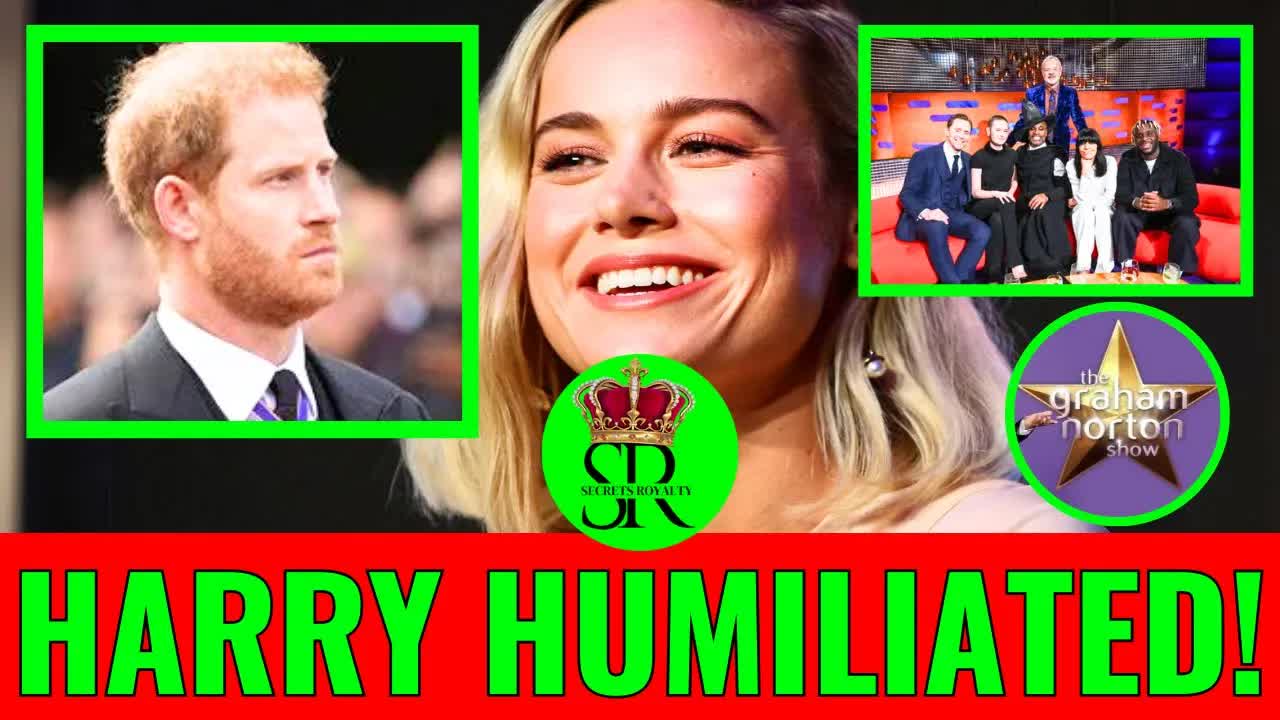
In a surprising twist during the latest episode of the Graham Norton Show, Prince Harry made headlines by walking off the set after actress Brie Larson poked fun at his request to be called “Your Royal Highness.” The unexpected moment unfolded when Larson’s sharp comment, which referenced Harry’s vocal criticism of the royal family, caught everyone off guard.
The audience’s reaction was electric, erupting into applause as Harry, visibly unsettled, left the stage mid-show.
This seemingly minor incident has sparked considerable debate about Harry’s public image and the monarchy’s relevance in today’s society.
It highlighted a growing perception that, despite his efforts to distance himself from royal life, Harry is still very much tied to his past—particularly in terms of how he expects to be treated.
Larson’s jibe resonated with many, reflecting a broader frustration with what some see as Harry’s sense of entitlement and mixed messages regarding his royal heritage.
Over the years, Harry has positioned himself as a critic of the monarchy, sharing candid insights into his upbringing and family dynamics through various platforms, including his memoir and a Netflix series.
He has painted a vivid picture of himself as a victim of royal constraints.
However, his insistence on maintaining certain royal protocols, like the formal address, seems at odds with his quest for independence, leading critics to accuse him of wanting to have it both ways.
The fallout from this recent live television confrontation has intensified scrutiny on Harry’s actions.
Commentators are split—some view him as a man courageously confronting his past, while others see him as someone who exploits his royal connections for personal gain.
This latest incident with Larson may have further damaged his credibility, reinforcing the notion that he still clings to the privileges he claims to reject.
This controversy also reignites discussions about the monarchy itself.
Harry’s estrangement from the royal family reflects deeper issues within the institution, which struggles to maintain its relevance amid public scrutiny.
The ongoing rift between Harry and the Windsors has captured media attention, casting a long shadow over the monarchy’s public perception.
For King Charles III, who has focused on modernization and unity, Harry’s actions present a personal and institutional challenge.
The royal family’s reputation has suffered in recent years, particularly among younger demographics.
Events like the one on the Graham Norton Show underscore a widening gap between contemporary values and traditional royal protocols.
Harry’s tumultuous journey, filled with public confrontations and controversies, raises pressing questions about the monarchy’s adaptability.
While he aims to be seen as an advocate for change, many perceive his narrative as increasingly self-serving.
His lucrative partnerships and media ventures have led some to accuse him of hypocrisy, especially regarding his selective use of royal heritage.
The ongoing rift between Harry and the royal family invites deeper existential questions about the monarchy’s future.
With internal conflicts spilling into the public eye, critics argue that the institution risks losing its aura of unity and stability, elements that have historically appealed to the British public.
The frequent revelations of family disputes, such as those detailed in Harry’s memoir, erode the mystique that once shielded the monarchy from criticism.
As Britain navigates its evolving identity, these familial tensions take on heightened significance.
The monarchy’s role in a democratic society, its connection with younger generations, and its ability to endure public scrutiny are all under the microscope.
While Harry’s estrangement may not solely cause this reckoning, it undeniably accelerates the process.
Currently, Prince Harry stands at a pivotal juncture.
His abrupt exit from the Graham Norton Show, prompted by Larson’s quip, encapsulates his struggle to reconcile his royal past with his current identity as a self-proclaimed advocate for change.
Whether this incident will prompt introspection or deepen divisions remains uncertain.
What’s clear is that Harry’s journey and its implications for the monarchy will continue to be a significant focus in the ongoing narrative of Britain’s royal family.
As the saga unfolds, both Harry and the institution he distanced himself from remain entwined in a complex and evolving story.