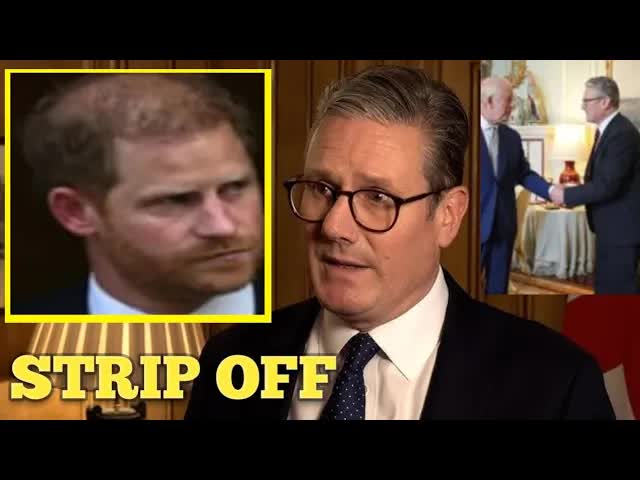
In a surprising twist in the ongoing saga of Prince Harry and Meghan Markle, UK Prime Minister Keir Starmer is reportedly contemplating the possibility of stripping Harry of his royal title.
This move comes in light of Harry’s recent claims regarding safety concerns during his visits to the UK.
Let’s unpack the situation and explore the arguments from both sides.
To understand the current debate, we have to rewind to 2020.
That was the year Harry and Meghan, the Duke and Duchess of Sussex, made headlines by announcing their decision to step back from their roles as senior royals.
They expressed a desire for financial independence and a wish to escape the relentless scrutiny of royal life, particularly in the UK.
This unprecedented decision sparked intense discussions and backlash among the public and royal watchers alike.
After negotiations with the Queen and other senior royals, Harry and Meghan agreed to give up their HRH titles but retained their Duke and Duchess titles.
They also committed to repaying taxpayer funds used for the renovation of their Frogmore Cottage residence.
Since relocating to California, the couple has been candid about their experiences with the British media and the royal family, often sharing their story in high-profile interviews.
One of the most notable moments came last year when they sat down with Oprah Winfrey.
During that interview, they made shocking allegations, including claims of racism within the royal family and a lack of support for Meghan’s mental health struggles.
Recently, Harry has taken legal action against the Home Office over its refusal to allow him to pay for police protection during his visits to the UK.
His lawyers contended that during a brief visit for Prince Philip‘s memorial service, Harry felt unsafe and could not rely on royal family members for protection.
These safety concerns have drawn significant criticism, particularly from Prime Minister Starmer.
In a recent interview, he voiced his apprehensions regarding Harry’s assertion that he cannot return to the UK with Meghan and their children due to safety issues.
Starmer emphasized that there are unresolved matters that need addressing and questioned how Harry could maintain both a royal identity while engaging in private commercial activities overseas.
Starmer’s comments prompted speculation about the possibility of pushing for Harry to lose his royal title.
While removing a title from a member of the royal family would be unprecedented, the debate surrounding this issue is complex, with valid points on both sides.
Supporters of stripping Harry’s title argue that he cannot simultaneously enjoy the benefits of royal status while rejecting royal duties.
They view it as hypocritical for him to market himself using his royal title to secure lucrative deals, such as those with Netflix, while distancing himself from royal responsibilities.
Critics also question the validity of his safety claims, pointing out that he has previously criticized the British press without facing any tangible threats during his visits.
Conversely, there are compelling arguments against the removal of Harry’s title.
Historically, royal titles have been held for life, and setting a precedent for stripping them could be seen as vindictive.
Such an action could tarnish the monarchy’s reputation both domestically and internationally.
Additionally, it might exacerbate already strained family relationships between Harry and the royal family, particularly with the Queen.
Moreover, Harry’s concerns about safety are rooted in a tragic family history.
His mother, Princess Diana, died in a car crash while being pursued by paparazzi, which understandably raises alarm bells for Harry regarding the safety of his own family.
Whether these threats are real or perceived, it is reasonable for him to seek protection.
Lastly, some argue that if Harry wishes to pursue private ventures in North America, that should not strip him of his royal titles, which are more about heritage than influence.
As long as he does not exploit these titles for commercial gain, keeping them could maintain a connection to royal history without causing disruption.
The debate surrounding Prince Harry’s royal title is emblematic of larger issues at play, such as the modernization of monarchy traditions, the complexities of family dynamics, and the appropriate response to perceived threats.
As the conversation continues, it will be interesting to see how this situation evolves and what it means for the future of the royal family.